Posted on

Cyber Hygiene from Childhood

Cyber Hygiene from Childhood: Estonia’s Lessons for Europe

Estonia is famous for its e-governance, but digital infrastructure is useless if the populace cannot navigate it safely. While many European countries are still debating when to introduce smartphones in schools, Estonia has integrated cybersecurity and digital literacy into its national curriculum from the earliest grades.

In Estonia, cyber-hygiene is treated with the same necessity as washing your hands or crossing the street safely.

The ProgeTiiger Legacy

Estonia’s educational approach goes back to the launch of the ProgeTiiger (ProgeTiger) program in 2012. Managed by the Education and Youth Board (Harno), this initiative ensures that coding, robotics, and digital safety are integrated into subjects from preschool through high school.

Instead of treating technology as an isolated subject taught in a dusty computer lab once a week, digital literacy is woven into everyday lessons:

  • Kindergarten: Children play with educational robots, learning the basics of sequencing and logical thinking.
  • Primary School: Students are introduced to the concept of digital identity, personal data protection, and the permanence of their digital footprint.
  • Secondary School: Curriculum modules cover phishing, social engineering, secure passwords (the “three random words” rule), and the mechanics of digital signatures.
  • Learning Through Gamification

Estonian schools reject dry lectures on cybersecurity. Instead, they rely on gamified learning, national quizzes (like the Küberpähkel or Cyber Nut competition), and interactive simulations. Students learn to spot real-world threats by hacking simulated networks or acting as “digital detectives” trying to find flaws in fake websites.

By demystifying the digital world, Estonia turns children from passive consumers of tech into active, security-conscious guardians of their own data. As cyberattacks and digital manipulation scale globally, the Estonian model offers Europe a vital blueprint: do not shield youth from the digital world; arm them with the skills to survive it.

Author: 
Posted on

New Media of Ida-Viru County

New Media of Ida-Viru County: How Young Activists in Narva and Sillamäe Are Building Independent Channels and Podcasts

Ida-Virumaa, Estonia’s easternmost region, has long been a subject of intense geopolitical scrutiny and media stereotyping. Dominated by a Russian-speaking population and industrial landscapes, the region’s actual youth culture is frequently ignored by mainstream national media.

Tired of seeing their hometowns portrayed solely through the lens of political tension, young activists in Narva, Sillamäe, and Jõhvi are taking the mic into their own hands. A new wave of independent podcasts, YouTube shows, and social media channels is emerging to tell the real stories of the border region.

Bypassing Traditional Gatekeepers

Historically, regional news was filtered through heavy political lenses or state broadcaster channels. Today’s youth are bypassing these traditional gatekeepers entirely.

  • Narva’s Creative Renaissance: Utilizing local creative hubs like the OBJEKT multimedia center, young creators are recording high-quality podcasts that explore topics like identity, mental health, and local urbanism.

  • Sillamäe’s Civic Media: Youth initiatives in Sillamäe are using platforms like Instagram and TikTok to organize community discussions, bridge gaps between local municipalities and the younger generation, and show the beauty of the Baltic coastline.

Rewriting the Narrative

These independent media channels serve a crucial double purpose. First, they provide local youth with a sense of pride and belonging, discussing subjects they actually care about—like regional job opportunities, local art, and skate culture. Second, they act as a cultural bridge to the rest of Estonia.

By producing content that is increasingly bilingual or subtitled, these young creators are showing their peers in Tallinn and Tartu that Ida-Virumaa is not a passive, detached borderland, but a vibrant, creative, and essential part of Estonia’s future.

Author: Dmitri Butsenko, youth activist

Posted on

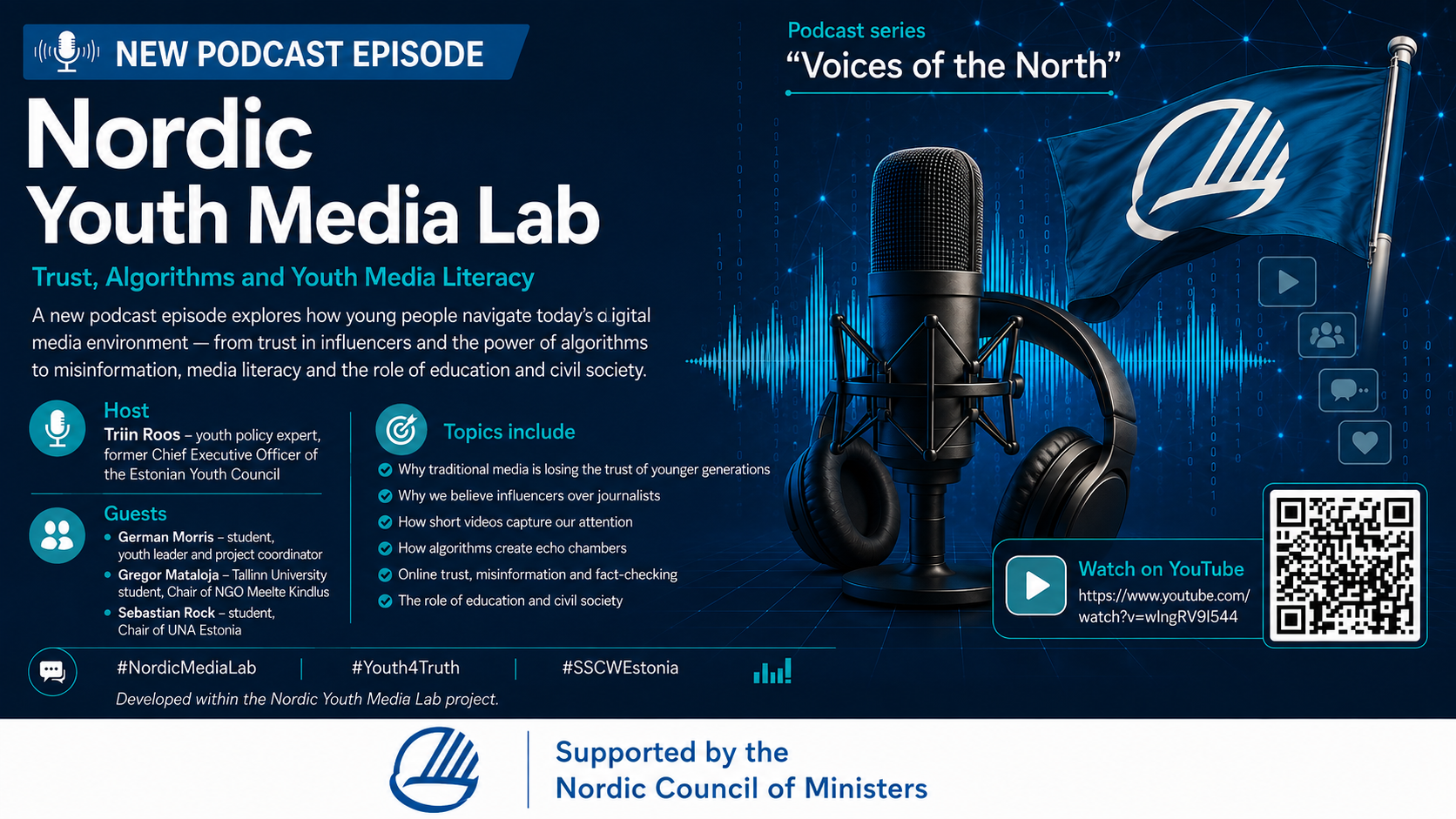
NYM Lab Podcast Explores Trust, Algorithms and Youth Media Literacy

A new podcast episode produced within the Nordic Youth Media Lab project explores how young people navigate today’s rapidly changing digital media environment.

The discussion is hosted by Triin Roos, youth policy expert and former Chief Executive Officer of the Estonian National Youth Council. She is joined by German Morris, student, youth leader and project coordinator; Gregor Mataloja, Tallinn University student and Chair of the NGO Meelte Kindlus; and Sebastian Rock, student and Chair of UNA Estonia.

Together, they discuss why younger audiences increasingly trust influencers over traditional media, how short-form content on TikTok and Instagram Reels captures attention, and how social media algorithms can create echo chambers and online “rabbit holes.” The episode also examines the psychology of online trust, misinformation, fact-checking, and the role of education and civil society in strengthening young people’s media literacy.

The podcast contributes to the development of a practical digital media learning programme created through a co-creation approach, involving young people, educators, youth workers and experts. The programme covers media and information literacy, artificial intelligence, digital ethics, safe online behaviour, podcast and video production, digital campaigns and democratic participation.

Watch the podcast on YouTube: https://www.youtube.com/watch?v=wlngRV9I544

The Nordic Youth Media Lab project is supported by the Nordic Culture Point’s Norden 0–30 programme and promotes youth cooperation, creativity and responsible digital participation across the Nordic and Baltic region.