Posted on

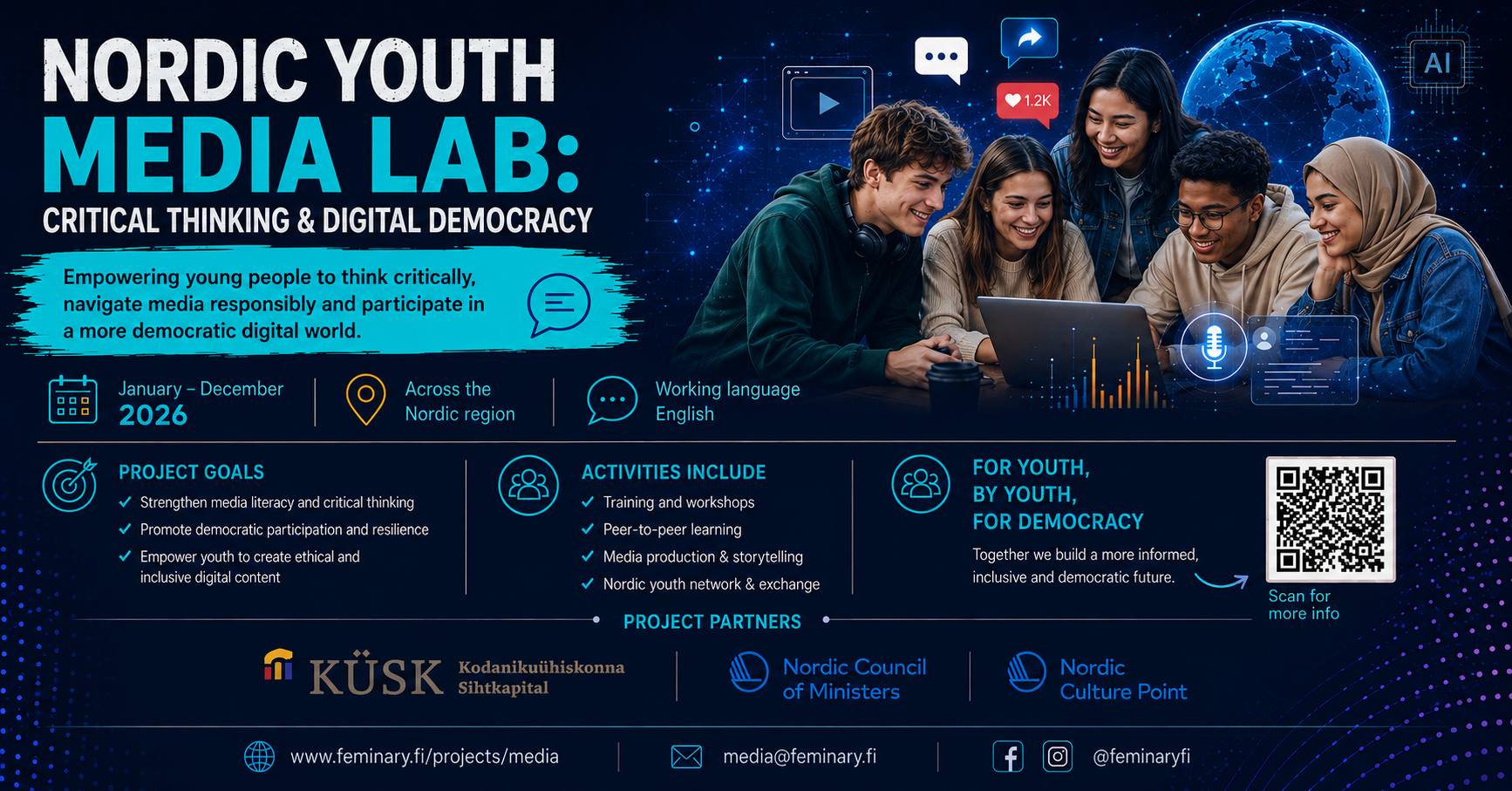
🎬 Nordic Youth Media Lab

Building Digital Skills, Critical Thinking and Democratic Participation

Nordic Youth Media Lab is an international initiative that empowers young people to become confident, responsible and creative participants in today’s digital society. Through practical learning, collaboration and innovation, the project strengthens media literacy, digital resilience and civic engagement across the Nordic and Baltic region.

Supported by the Nordic Culture Point – Norden 0–30 Programme, the project brings together young people, youth workers, educators and experts to co-create innovative learning experiences that respond to the rapidly changing digital landscape.


Why This Project Matters

Digital technologies have transformed the way young people learn, communicate and participate in society. Alongside new opportunities, they face increasing challenges such as misinformation, artificial intelligence, online manipulation, cyberbullying and information overload. To thrive in this environment, young people need more than technical skills. They need critical thinking, ethical awareness, media literacy and the confidence to create trustworthy digital content. Nordic Youth Media Lab helps young people develop these essential competences while encouraging active citizenship, democratic participation and cross-border cooperation.


Our Mission

Our mission is to strengthen young people’s ability to:

  • think critically;
  • evaluate information responsibly;
  • understand the impact of artificial intelligence on media;
  • create ethical digital content;
  • participate actively in democratic life;
  • collaborate across cultures and borders.

The project creates a safe and inclusive learning environment where every participant can develop practical digital competences while building confidence and leadership skills.


Learning Through Co-Creation

A distinctive feature of the project is its co-creation methodology.

Instead of developing educational materials behind closed doors, the curriculum is created together with:

  • young people;
  • youth workers;
  • educators;
  • communication specialists;
  • media professionals;
  • researchers.

This collaborative approach ensures that learning materials reflect real challenges, current technologies and the actual needs of young people.

Through workshops, discussions, pilot activities and feedback sessions, participants become active contributors to the educational process rather than passive learners.


Expected Impact

The project contributes to:

  • improved digital competence among young people;
  • stronger media literacy;
  • increased resilience against misinformation;
  • greater confidence in using digital technologies;
  • enhanced creativity and communication skills;
  • stronger international cooperation between Nordic and Baltic youth organisations;
  • development of innovative educational resources available for future use.

International Cooperation

Nordic Youth Media Lab promotes cooperation between organisations, educators and young people across the Nordic and Baltic countries.

Participants exchange experiences, share ideas and develop solutions that strengthen democratic values, intercultural dialogue and social inclusion.

This international perspective helps young people better understand different societies while preparing them to become active European citizens.


Together We Create the Future of Digital Education

Digital transformation requires new knowledge, new skills and new ways of learning.

Nordic Youth Media Lab is more than a training programme—it is a collaborative platform where young people develop the competences needed to navigate an increasingly complex digital world with confidence, responsibility and creativity.

Together we are building a future where young people are not only consumers of digital media but informed creators, critical thinkers and active contributors to democratic society.

Programme is supported by the Nordic Culture Point – Norden 0–30 Programme.

Posted on

Young People in the Labor Market

In today’s society, working while studying has become a natural part of life for many young people. College and high school students find jobs in the service industry, logistics, and retail, or try their hand at freelancing on online platforms. This practice is undoubtedly of great value, as it develops communication skills, fosters a sense of responsibility, and provides initial financial independence. At the same time, this apparent freedom also hides a serious risk. When entering the job market, young people often encounter situations where they are not sufficiently aware of their rights or able to recognize potential risks. In my view, a basic understanding of labor law is essential, as it helps prevent unfair conditions and creates a safer work environment for all of us.

One of the most pressing issues is young people’s willingness to work without a formal contract. The desire to earn an independent income quickly, combined with naive trust in the employer, often plays a cruel trick on newcomers. When the relationship is governed solely by a verbal agreement, the risk of facing delayed wages, non-payment of agreed-upon amounts, or sudden dismissal is very high. Proving your rights after the fact is legally nearly impossible in such a situation. Therefore, it is crucial to agree on all terms before the first day of work and to begin fulfilling your obligations only after both parties have unambiguously signed the document.

Even when an employer offers a formal contract, people run into the next obstacle: an inability or unwillingness to read the document carefully. A common mistake is to scan the text for just one number-the amount of pay. However, equally important points-such as a specific list of job duties, workload, break times, and the probationary period-are overlooked. Complex legal language may seem incomprehensible to a young person, and instead of asking for clarification, they sign the contract blindly. A widespread sense of false shame in society prevents people from asking questions, even though, in reality, seeking clarification demonstrates a mature, responsible, and professional attitude. Everyone should know exactly what they are agreeing to before signing.

In addition to superficiality, a serious challenge is a lack of understanding of the contents of various types of contracts. Some companies deliberately exploit agency or service contracts in situations where a person is actually performing regular salaried work. As a result of such schemes, young employees are deprived of paid vacation, sick leave, and other social benefits. If a company has complete control over an employee’s time, place of work, and work process, this constitutes a classic employment relationship that requires an employment contract. Unfortunately, entry-level employees often don’t notice these legal nuances until they face their first health issues or need to take time off.

The issue of fair compensation is also closely tied to self-respect. During job interviews, a higher salary may be promised, but in reality, the actual amount turns out to be lower, or payments are regularly delayed. Since people starting their careers fear conflict or losing their jobs, they often endure such behavior in silence. In my opinion, no one should be afraid to defend their legal rights. If a person does not learn to assert themselves from the very beginning, similar problems and exploitation may continue to plague them in the future.

Work, however, should not become merely a means of survival, because in addition to the financial aspect, the employee’s mental and physical well-being is at stake. Constant attempts to juggle school and extra shifts lead to chronic fatigue, stress, and sleep problems. Some employers expect young people to be completely flexible and ready to rush to the rescue at any time, which has a devastating effect on both their studies and their health. Quality employment always means a balance that leaves room for people to rest and grow. An employee who is constantly exhausted will inevitably lose motivation, and with it, the quality of their work.

The situation is made even more complex by the fact that the modern labor market is changing rapidly due to technology. Platform work-whether it involves courier services, content creation, or freelancing-attracts young people with its apparent freedom. The flip side of this coin, however, is the lack of a stable income and social protection. Before diving into this type of digital entrepreneurship, one should thoroughly research the associated obligations and risks. As ways of working become even more flexible in the future, the importance of knowledge in the field of labor law will also increase.

In conclusion, it can be said that most of the problems described stem purely from a lack of knowledge. It would be appropriate for schools and universities to pay more attention to practical aspects of working life, the analysis of documents, and the resolution of real-world situations. If young people learn to ask questions and know how to seek help when necessary, the entire work environment will become fairer and safer. Work should not be merely an obligation to earn money, but an environment where people are treated with respect. A basic understanding of labor law gives young people self-confidence, helps them make more informed decisions, and lays a stronger foundation for the future.


Author:  German Morris