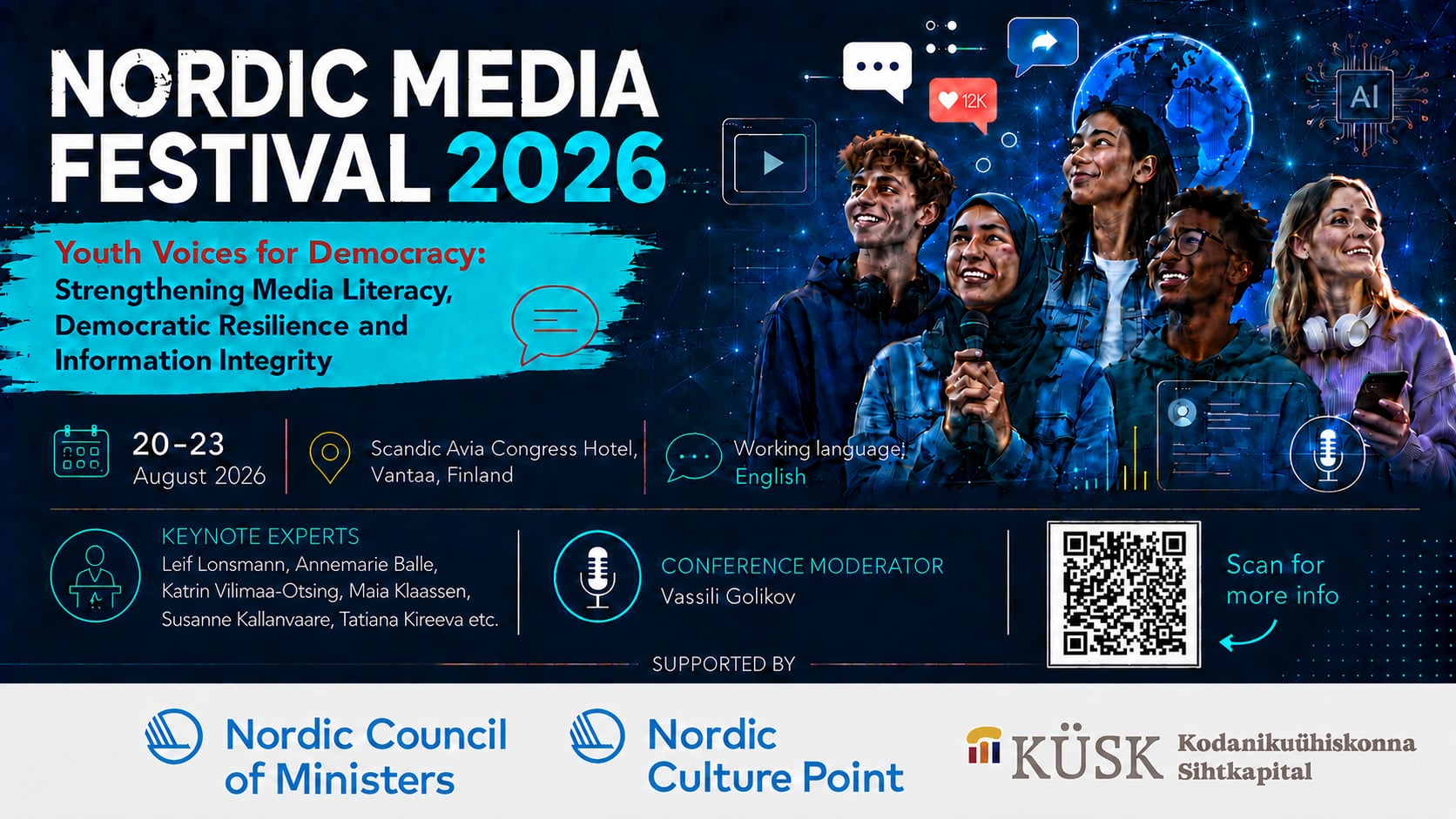
The Nordic Media Festival 2026, entitled “Youth Voices for Democracy: Strengthening Media Literacy, Democratic Resilience and Information Integrity,” will take place from 20 to 23 August 2026 at the Scandic Avia Congress Hotel in Vantaa, in the Greater Helsinki area of Finland.
The four-day international gathering will bring together young people, educators, journalists, media professionals, researchers, policymakers and civil society representatives from across the Nordic–Baltic region. Organised by Femina ry and the Sillamäe Society for Child Welfare (SSCW) in cooperation with Nordic partners, the Festival will create a platform for learning, dialogue and practical cooperation on some of the most urgent challenges facing contemporary media and democratic societies.
Young people are growing up in a digital environment increasingly shaped by artificial intelligence, social media algorithms, influencers, information overload, disinformation and rapidly changing technologies. The Festival will examine how young people can navigate this environment responsibly while becoming active content creators, storytellers, fact-checkers, community leaders and contributors to democratic resilience.
Nordic Media Conference on 21 August
The central event of the Festival will be the Nordic Media Conference on 21 August, featuring keynote contributions, expert panels and youth-led working groups.
The conference will include keynote contributions from Leif Lønsmann of the Nordic Journalism Centre and Maia Klaassen of the University of Tartu.
The first panel, “Growing Up in the Digital Age: Youth, Identity and Cognitive Wellbeing,” will explore how social media, information overload and the attention economy affect young people’s identity, emotional wellbeing and resilience. Participants will discuss online pressure, comparison culture, healthy digital habits and ways of supporting young people’s cognitive wellbeing.
The second panel, “Critical Thinking and Fighting Disinformation in the Age of AI,” will examine misinformation, propaganda, deepfakes and AI-generated content. Journalists, researchers and media experts will discuss practical fact-checking and source-verification skills, the democratic importance of media literacy and ways of strengthening young people’s information resilience.
The third panel, “Social Media, Influencers and Civic Participation,” will focus on the role of content creators and digital opinion leaders in public life. The discussion will consider how social media can be used responsibly to encourage youth activism, constructive dialogue, community participation and positive social impact.
The conference will conclude with cross-national youth working groups under the theme “Youth Voices and Democratic Resilience: Preparing for Future Challenges.” Participants will formulate recommendations addressing democratic participation, polarisation, social cohesion, community action, responsible media use and information integrity.
These recommendations will contribute directly to the Nordic Youth Media Manifesto, one of the Festival’s principal outcomes.
Digital exhibition and opening discussions
The Festival will begin on 20 August with the arrival of national delegations, opening discussions and a digital exhibition showcasing media content created by young participants.
The exhibition will provide young people with an opportunity to present their perspectives through videos, interviews, photographs, podcasts, social media materials and other digital formats. It will highlight young people not only as consumers of information but also as responsible media creators capable of influencing public conversations and strengthening their communities.
Youth Media Skills and Digital Activism Lab
On 22 August, the Festival will continue with the practical Youth Media Skills and Digital Activism Lab. The programme is designed for young people, youth leaders, content creators, media activists and emerging journalists.
The laboratory will include three practical workshops:
- “Verify Before You Share: Fact-Checking and AI Content Detection,” led by Katrin Vilimaa-Otsing, will introduce participants to source verification, reverse-image searches and methods for recognising manipulation, deepfakes and AI-generated content.
- “Create for Change: Digital Storytelling and Community Journalism,” led by Tatiana Kireeva, will help participants transform local and social issues into clear, engaging and human-centred media stories while avoiding sensationalism and stereotypes.
- “From Post to Participation: Designing a Youth Digital Activism Campaign,” led by German Morris of Peace Child Estonia, will guide teams through the development of small digital campaigns supporting meaningful participation and positive community action.
During the workshops, participants will create fact-checks, storyboards, video or podcast concepts, social media content and digital campaign proposals. Selected results may be presented through the Festival’s digital exhibition and further developed as contributions to the Nordic Youth Media Manifesto.
Media interaction and Nordic–Baltic networking
The afternoon programme on 22 August is planned to include an interaction with representatives of Yle, Finland’s national public-service media company. Depending on availability, the meeting may take place in person or online.
The session will give participants an opportunity to learn about professional journalism, content production, public-service media standards and the role of trusted media in democratic society. It will also offer young participants practical insights into Finland’s experience in media literacy, youth engagement and public-service broadcasting.
An informal networking programme will provide additional space for participants, experts and national delegations to exchange experiences, establish professional contacts and discuss future Nordic–Baltic cooperation in journalism, media education, digital communication and youth participation.
Nordic Youth Media Manifesto
On 23 August, participants will present the results of their work and formally adopt the Nordic Youth Media Manifesto.
The youth-led document will set out recommendations for strengthening media literacy, democratic participation, cognitive wellbeing and information resilience across the Nordic–Baltic region. It will reflect the experiences and priorities of young people and offer proposals for educators, media organisations, civil society, policymakers and youth networks.
Through its combination of expert knowledge, youth participation, practical media work and cross-border cooperation, the Nordic Media Festival aims to empower young people to think critically, protect their wellbeing, use digital technologies responsibly and participate actively in democratic and inclusive societies.
Practical information
📅 20–23 August 2026
📍 Scandic Avia Congress Hotel, Vantaa, Finland
🌐 Working language: English
👥 Participants: young people, educators, journalists, media professionals, researchers, policymakers and civil society representatives
The full programme and event updates are available on the Nordic Media Festival 2026 webpage.
Further information: info@sscw.ee / feminasuomi@gmail.com
The Nordic Media Festival is organised with financial support from the Nordic Council of Ministers through the Norden 0–30 grant programme and from the National Foundation of Civil Society (SA Kodanikuühiskonna Sihtkapital), with contributions from the Nordic Journalism Centre (Nordisk Journalistcenter, NJC).